

Restoring Curved, Spiral, and Winder Staircases in Historic NYC Homes
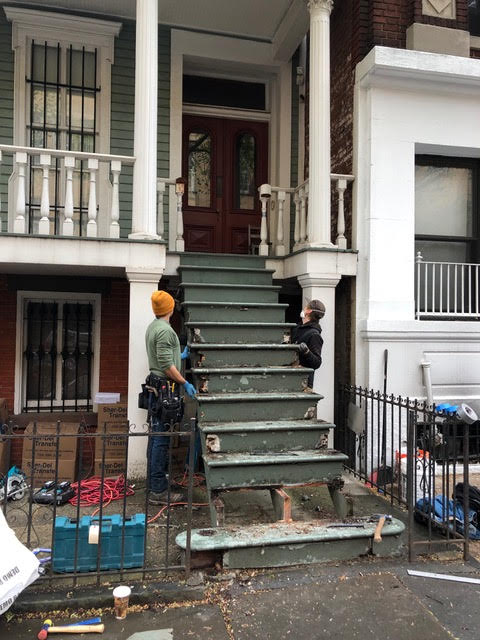
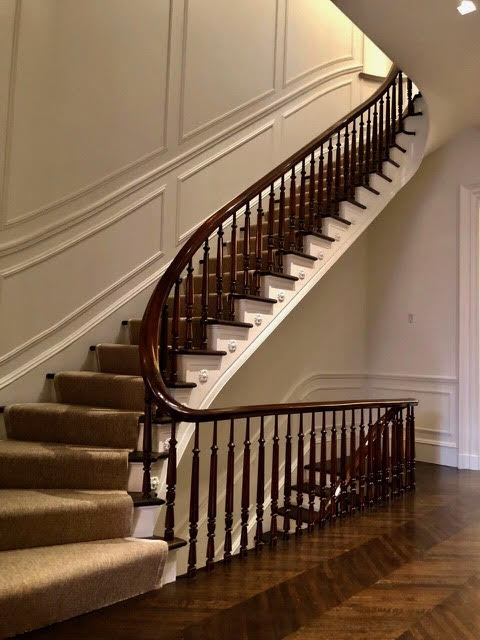
A straight staircase is honest carpentry. A curved staircase is sculpture that happens to carry people between floors. New York's grander brownstones, townhouses, and pre-war apartment buildings are full of them: sweeping curved runs in Brooklyn Heights parlors, tight winders in Greenwich Village row houses, and the occasional full spiral tucked into a turret or rear extension.
These stairs are also where restoration gets genuinely difficult. Curved work cannot be ordered from a catalog, and every component was made by hand for one specific arc. At Fifty Three Restorations in Long Island City, curved and winding stairs are some of the most demanding projects we take on, and some of the most rewarding.
Own a curved or winding staircase that needs attention? Start the conversation.
The Three Types of Non-Straight Staircases
People call anything that turns a "spiral staircase," but the trade draws sharper lines.
Curved staircases change direction along a smooth arc, usually with a continuous handrail that sweeps from floor to floor. The rail alone is a feat: historically it was made by cutting the curve from stacked blocks of wood or by steam-bending and laminating thin strips.
Winder staircases turn a corner using pie-shaped treads instead of a flat landing. Common in space-tight NYC row houses, winders concentrate wear on the narrow end of each tread and put twisting loads on the stringers.
Spiral staircases wind around a central column. Victorian iron spirals survive in rear extensions and servant stairs, and wood-spiraled versions appear in turrets and libraries. Every tread is a unique wedge, and the rail is a continuous helix.
Why Curved Work Costs More and Takes Longer
Owners of curved stairs are sometimes surprised by estimates, so it helps to understand what the money buys.
- Every part is custom. A curved handrail fitting, a winding tread, or a bowed riser cannot be reordered. Each one is laid out from the existing geometry and made in the shop.
- The geometry is unforgiving. On a straight stair, a new tread is a rectangle. On a curved stair, each tread has its own radius, and a millimeter of error at the stringer becomes a visible gap at the nosing.
- Hidden structure is harder to reach. Curved stairs often rely on carriage timbers and brackets buried in plaster. Diagnosing looseness can mean working blind from below or carefully opening finishes that are themselves historic.
- Finish work is slower. Curved rails and turned balusters cannot be run through wide-belt sanders. They are stripped, sanded, and finished by hand.
Common Problems in NYC's Curved and Winding Stairs
The failure patterns we see most often in New York's older non-straight staircases:
- Loose or cracked rail easings. The curved sections of rail, where grain runs short, crack under decades of hand pressure and building movement.
- Worn winder treads. The narrow end of a pie-shaped tread carries the same foot traffic in a third of the area, so winders dish out and loosen before straight treads do.
- Open stringer joints. Seasonal humidity swings, the same force behind the movement we describe in our post on New York humidity and wooden staircases, work curved joints apart faster because curved joinery has less mechanical lock than straight mortise-and-tenon work.
- Past repairs that fought the curve. We regularly find curved rails "fixed" with straight lumber, metal straps, or construction adhesive. These repairs usually fail and often damage the original wood around them.
How Professional Restoration Approaches the Curve
A proper curved-stair restoration starts with documentation. Before anything comes apart, the geometry gets recorded: rail heights, radii, tread shapes, and baluster spacing, so every removed piece can go back exactly where it came from.
Repairs then split between site and shop. Structural tightening, wedge and joint work, and re-anchoring happen in place. Components that need milling, such as new winder treads, spliced rail sections, or replacement balusters, are made in the shop from species-matched lumber, using the originals as patterns. Our period reconstructions work follows the same discipline: reproduce the profile, match the species, and blend the finish so the repair disappears.
The goal is always the same: keep every sound original piece, replace only what has failed, and leave the curve reading as one continuous gesture, the way the original builder intended. Our Wood Staircases and Handrails service handles the full range, from tightening a loose curved rail to reconstructing sections that past remodels removed.
What Owners Can Do Between Restorations
- Watch the rail first. New movement or a fresh crack line in a curved rail is early warning. Caught early, a splice repair is modest; left alone, the crack travels.
- Mind the winders. If the narrow ends of winder treads feel soft or sound hollow, have them assessed before they split.
- Control humidity. Stable indoor humidity slows the seasonal movement that opens curved joints. It is the single cheapest preservation measure you own.
- Skip the strap-and-screw fixes. Hardware-store repairs on curved components usually create the next, larger repair.
For a broader look at deciding between saving and replacing historic fabric, see our post on restoring original staircases in Brooklyn brownstones.
Frequently Asked Questions
Can a curved wooden handrail be repaired, or does it have to be replaced?
Most cracked or loose curved rails can be repaired in kind: re-glued, spliced with matched grain, or reinforced from within. Full replacement is the exception, reserved for rails that have failed along their whole length.
Are spiral staircases in old NYC buildings original?
Often yes, especially Victorian iron spirals in rear extensions and service stairs. Wood spirals in turrets and libraries are frequently original to 19th-century construction. An assessment can usually date the stair from its joinery and fasteners.
Why does my winder staircase feel bouncy near the turn?
Winder treads concentrate load on their narrow ends and on the angled stringers below them. Decades of that focused stress loosen the joinery, producing flex and squeaks. The fix is structural, tightening and re-supporting the winders from below.
Does restoring a curved staircase require landmark approval in NYC?
Interior work on a private residence is often outside Landmarks Preservation Commission review, but buildings with interior landmark designations and certain public-facing spaces are different. When in doubt, confirm with the LPC or a preservation professional before work begins.
How long does curved staircase restoration take?
Longer than straight-run work, because components are shop-made to the existing geometry. A rail repair might take days; reconstructing a run of winders with custom treads is measured in weeks, much of it off site in the shop.
Project Spotlight: Rebuilding What Time Took Apart
Our staircase reconstruction project shows the shop-and-site discipline this work demands: careful documentation, components reproduced to the original geometry, and a finished stair that reads as one continuous piece of craft. Curved or straight, the standard does not change.
Fifty Three Restorations Serving the Park Slope Community and Beyond in Long Island City
Fifty Three Restorations works to meet the woodworking needs of the local community across Long Island City. From our shop near Queens, we proudly handle curved and spiral staircase restoration for homeowners and property owners throughout New York City.
Our shop sits at 38-16 Skillman Ave # B, Long Island City, NY 11101. From there our team reaches clients in Park Slope, Brooklyn Heights, Carroll Gardens, Greenpoint, and the Upper West Side, and we serve customers across Brooklyn, Queens, Manhattan, and the surrounding communities.
Quick Access Information
- 📍 About 15 minutes from Grand Army Plaza and Prospect Park via the BQE
- 🚗 Easy access via the Brooklyn-Queens Expressway (I-278) and Queens Boulevard
- 🌆 Serving residents across Park Slope, Brooklyn Heights, and Carroll Gardens
Driving Directions from Park Slope to Fifty Three Restorations
<iframe src="https://www.google.com/maps/embed?pb=!1m18!1m12!1m3!1d3022.670979246106!2d-73.9260912!3d40.747264799999996!2m3!1f0!2f0!3f0!3m2!1i1024!2i768!4f13.1!3m3!1m2!1s0x89c25f2822fcc717%3A0xb0f6d7a4c4f548ac!2sFifty%20Three%20Restorations%20Inc!5e0!3m2!1sen!2sph!4v1776106836033!5m2!1sen!2sph" width="600" height="450" style="border:0;" allowfullscreen="" loading="lazy" referrerpolicy="no-referrer-when-downgrade"></iframe>
From Park Slope, take the Brooklyn-Queens Expressway (I-278) north toward Queens, exit toward Long Island City, and follow local streets to Skillman Avenue and 38-16 Skillman Ave # B. The drive typically runs 20 to 25 minutes outside rush hour.
Business Hours and Contact
- Business name: Fifty Three Restorations
- Address: 38-16 Skillman Ave # B, Long Island City, NY 11101
- Phone: (212) 566-1053
- Email: info@fiftythreerestorations.com
- Website: https://fiftythreerestorations.com
Hours
Monday to Friday: 8:00 AM to 4:30 PM
Saturday: By appointment
Sunday: Closed
Call during business hours and a member of our team will talk through your project, answer questions, and set up a site visit. Prefer to write first? Send a note through our Contact Us page and we will reply quickly. (Please confirm current hours by phone before visiting.)
Ready to Bring Back the Curve
A curved staircase is the centerpiece of a historic home, and it deserves hands that respect the geometry. If yours has loosened, cracked, or suffered a bad repair, let us look at it before the damage travels further.
Fifty Three Restorations has served New York since 1990, and our Long Island City team is ready to help. Call (212) 566-1053 or visit https://fiftythreerestorations.com/contact-us to request a proposal. We would be glad to help your staircase keep its sweep for another century.
Follow Fifty Three Restorations
- Facebook: https://www.facebook.com/iconicnewyorkbuildings
- Instagram: https://www.instagram.com/53restorations/
- LinkedIn: https://www.linkedin.com/company/fifty-three-restorations-inc/
Sources
- USDA Forest Products Laboratory, Wood Handbook | U.S. Department of Agriculture, Forest Service | 2021 | https://research.fs.usda.gov/treesearch/62261
- NYC Landmarks Preservation Commission | https://www.nyc.gov/site/lpc/index.page
Related Resources
Explore More Insights

Get Started with Your Project
Contact us today to schedule a consultation.
