

Newel Posts, Balusters, and Stringers: A Plain-English Guide to the Parts of Your Staircase
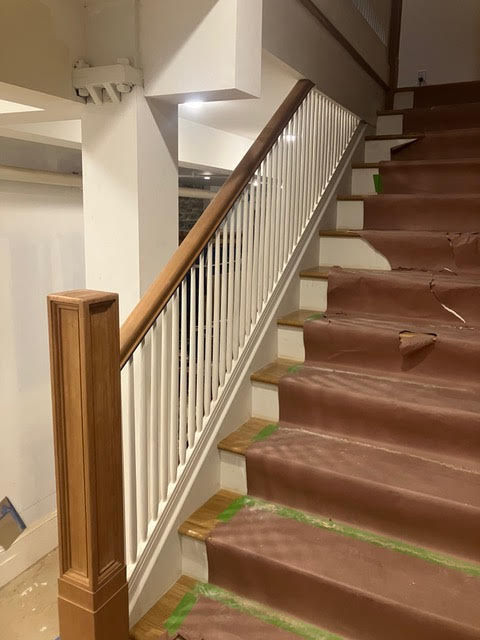
A contractor stands at the bottom of your stairs, points up, and says the gooseneck is split and two balusters need turning. You nod like that sentence made sense. Most New York homeowners have walked their staircase ten thousand times without learning the names of its parts, and that gap makes every repair conversation harder than it needs to be.
The vocabulary is simpler than it sounds. A staircase has maybe a dozen named parts, and once you know them you can describe problems accurately, understand estimates line by line, and spot the difference between a cosmetic issue and a structural one. At Fifty Three Restorations in Long Island City, these are the terms we use every day in New York's older homes.
Have a part that needs attention? Talk to our stair team.
The Walking Surface: Treads and Risers
The tread is the horizontal board you step on. The riser is the vertical board that closes the gap between one tread and the next. Together they form each step.
In older NYC homes, treads were often milled from a single wide board of old-growth wood, which is one reason they survive a century of use. Watch for treads that have worn into a dish shape, cracked along the grain, or pulled away from the riser behind them. A nosing is the rounded front edge of the tread that overhangs the riser, and it takes the brunt of foot traffic.
The Backbone: Stringers
The stringer is the diagonal board that runs along the side of the staircase and carries the treads and risers. Most stairs have two or three: one against the wall, one on the open side, and sometimes a center stringer for wide runs.
Stringers matter because they are structure, not decoration. A cracked or sagging stringer is the staircase equivalent of a cracked floor joist, and it is one of the warning signs covered in our post on when a staircase needs restoration. On many older New York stairs, the open-side stringer is "housed," meaning the treads and risers sit in routed grooves held tight by wedges underneath, a detail that explains why those hidden wedges loosen and squeak over the decades.
The Anchors: Newel Posts
The newel post is the large, solid post at the bottom of the staircase, at landings, and sometimes at the top. It anchors the handrail system, and in Victorian and Edwardian homes it is often the most decorated single piece of wood in the entry hall, turned, carved, or capped with a finial.
A newel that moves when you lean on it is more than an annoyance. Because the handrail system keys into the newels, a loose newel undermines the stability of the whole rail. Properly re-anchoring one usually means fastening it to the floor structure below, not just tightening visible screws.
The Infill: Balusters and Balustrades
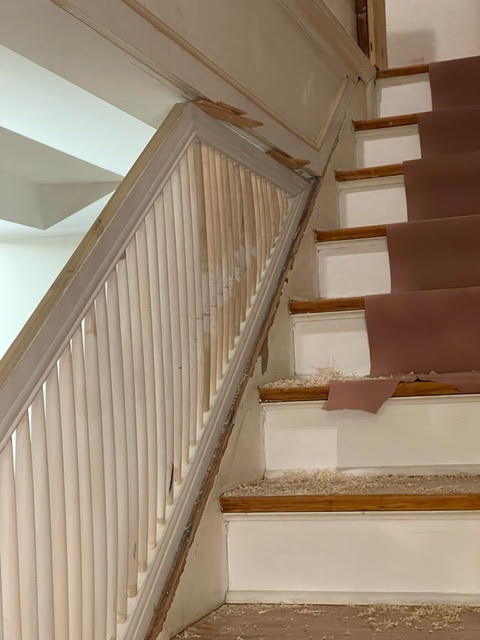
Balusters are the vertical spindles between the handrail and the treads. A run of balusters plus the rail above them is called a balustrade. Older NYC staircases carry balusters in every turning profile imaginable, and matching a broken one means copying the profile by eye and lathe, something our guide to matching new treads and balusters to a 100-year-old staircase explains in detail.
Balusters also carry a safety function: they keep children and pets from slipping through the open side. Wobbly or missing balusters deserve prompt attention, especially in multi-family buildings.
The Parts You Grip: Handrails, Goosenecks, and Volutes
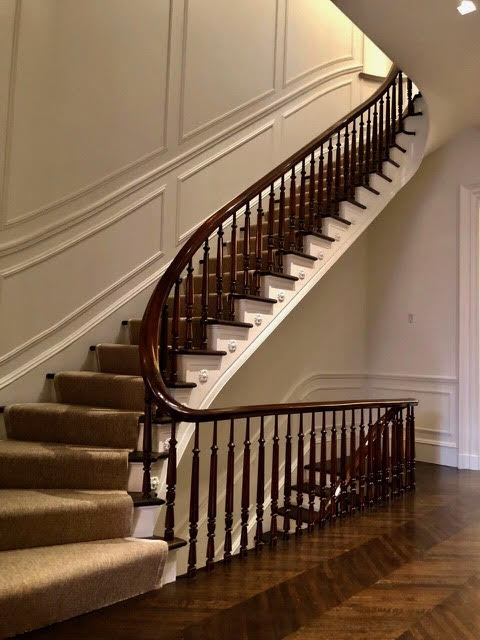
The handrail is the shaped rail you hold. Where the rail changes direction, it picks up special names. A gooseneck is the curved fitting that carries the rail up from a landing to the next flight. A volute is the spiral scroll that finishes the rail over the starting newel on many formal stairs. An easing is any shorter curve that smooths a change in slope.
These fittings are where historic stairs most often crack, because curves cut across the wood grain. They are also among the hardest parts to reproduce, which is why original goosenecks and volutes are worth repairing rather than discarding.
Why the Vocabulary Pays Off
Knowing these names changes three conversations. First, you can describe damage precisely: "the gooseneck is split" gets a useful answer faster than "the bendy part is broken." Second, you can read an estimate critically, because every line item names a part. Third, you can tell urgent from cosmetic: a wobbly newel or cracked stringer is structural, while a scuffed tread or loose baluster knob can wait for a planned restoration.
When you are ready for that conversation, our Wood Staircases and Handrails team speaks this language fluently, and we are happy to translate.
Frequently Asked Questions
What is the difference between a baluster and a spindle?
In everyday use they mean the same thing: the vertical pieces filling the space between the handrail and the steps. "Baluster" is the traditional term you will see on estimates and landmark documents; "spindle" is the casual one.
Why is my newel post loose, and is it serious?
Newels loosen as their anchor into the floor framing works free over decades of sideways pressure. It is worth fixing soon, because the whole handrail system depends on the newel for stability, and a failing rail is a safety issue on a busy stair.
Can a single broken baluster be replaced to match?
Yes. A turning shop can copy the profile of a surviving baluster and stain the replacement to blend. In century-old New York staircases, exact matching is routine work for a restoration shop and nearly impossible with off-the-shelf parts.
What is the skirt board?
The skirt board (or skirt) is the trim board that runs diagonally along the wall or the open side of the stair, covering the joint between the staircase and the wall. It is decorative, but it also hides the ends of housed stringer joinery.
How do I know if a crack in my staircase is structural?
Cracks in stringers, treads that flex underfoot, and any movement in the rail system deserve a professional look. Surface cracks in a nosing or riser are usually cosmetic. When in doubt, have it assessed; a look costs little compared to a failed step.
Customer Success Story
When Asbury United Methodist Church needed careful work on a 100-year-old Rose Window, they called Fifty Three Restorations. Anne Leclercq recalled how our team, led by Vince, coordinated with the glass contractor, communicated clearly with the parish, and finished on time. "It was reassuring to work with experienced professionals who care about their work," she said. The same component-by-component care that protects a century-old window goes into every tread, newel, and baluster we touch.
Fifty Three Restorations Serving the Greenpoint Community and Beyond in Long Island City
Fifty Three Restorations works to meet the woodworking needs of the local community across Long Island City. From our shop near Queens, we proudly handle staircase repair and restoration for homeowners and property owners throughout New York City.
Our shop sits at 38-16 Skillman Ave # B, Long Island City, NY 11101. From there our team reaches clients in Greenpoint, Williamsburg, Astoria, Sunnyside, and the East Village, and we serve customers across Brooklyn, Queens, Manhattan, and the surrounding communities.
Quick Access Information
- 📍 About 10 minutes from the Pulaski Bridge and McCarren Park
- 🚗 Easy access via the Brooklyn-Queens Expressway (I-278) and the Long Island Expressway (I-495)
- 🌆 Serving residents across Greenpoint, Williamsburg, and Astoria
Driving Directions from Greenpoint to Fifty Three Restorations
<iframe src="https://www.google.com/maps/embed?pb=!1m18!1m12!1m3!1d3022.670979246106!2d-73.9260912!3d40.747264799999996!2m3!1f0!2f0!3f0!3m2!1i1024!2i768!4f13.1!3m3!1m2!1s0x89c25f2822fcc717%3A0xb0f6d7a4c4f548ac!2sFifty%20Three%20Restorations%20Inc!5e0!3m2!1sen!2sph!4v1776106836033!5m2!1sen!2sph" width="600" height="450" style="border:0;" allowfullscreen="" loading="lazy" referrerpolicy="no-referrer-when-downgrade"></iframe>
From Greenpoint, take Greenpoint Avenue east across the Pulaski Bridge into Long Island City, then continue to 21st Street and turn toward Skillman Avenue. Follow Skillman to 38-16 Skillman Ave # B. Most drivers arrive in about 10 minutes.
Business Hours and Contact
- Business name: Fifty Three Restorations
- Address: 38-16 Skillman Ave # B, Long Island City, NY 11101
- Phone: (212) 566-1053
- Email: info@fiftythreerestorations.com
- Website: https://fiftythreerestorations.com
Hours
Monday to Friday: 8:00 AM to 4:30 PM
Saturday: By appointment
Sunday: Closed
Call during business hours and a member of our team will talk through your project, answer questions, and set up a site visit. Prefer to write first? Send a note through our Contact Us page and we will reply quickly. (Please confirm current hours by phone before visiting.)
Ready to Talk About Your Staircase
Whether it is one loose baluster or a rail system that has not felt solid in years, a short conversation can tell you what you are looking at and what it takes to fix.
Fifty Three Restorations has served New York since 1990, and our Long Island City team is ready to help. Call (212) 566-1053 or visit https://fiftythreerestorations.com/contact-us to request a proposal. Your staircase has a story worth keeping, and we would be glad to help you protect it.
Follow Fifty Three Restorations
- Facebook: https://www.facebook.com/iconicnewyorkbuildings
- Instagram: https://www.instagram.com/53restorations/
- LinkedIn: https://www.linkedin.com/company/fifty-three-restorations-inc/
Sources
- USDA Forest Products Laboratory, Wood Handbook | U.S. Department of Agriculture, Forest Service | 2021 | https://research.fs.usda.gov/treesearch/62261
- NYC Landmarks Preservation Commission | https://www.nyc.gov/site/lpc/index.page
Related Resources
Explore More Insights

Get Started with Your Project
Contact us today to schedule a consultation.
