

Refinishing vs. Replacing Wooden Stairs: How to Decide
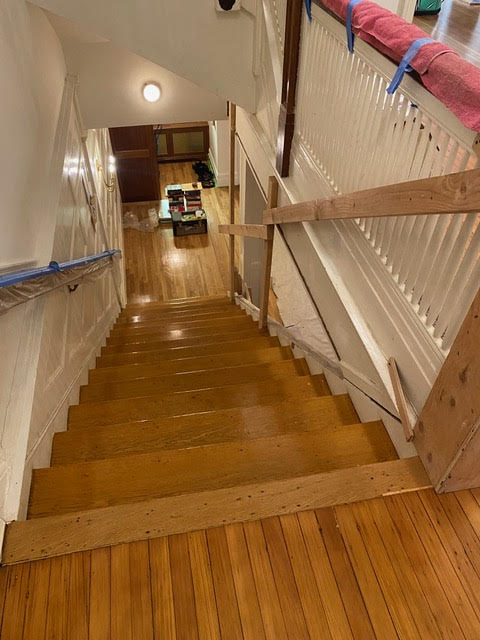
Most staircase projects stall at the same crossroads. You stand at the bottom of a tired old stair, look at the worn treads and dull finish, and freeze on one question: do I refinish this, or rip it out and replace it? Pick wrong in either direction and you waste money. Refinish a staircase that is structurally failing, and you polish a problem. Replace one that just needed a refresh, and you throw away sound, irreplaceable wood.
Here is the relief. The decision usually comes down to a few simple questions about structure, not looks. Looks can almost always be restored. Structure is what tips the scale. At Fifty Three Restorations in Long Island City, we walk New York homeowners through this fork every week, and most of them keep their stairs. Let's break it down so you can point yourself the right way before a single tool comes out.
Understanding the Problem: Looks Versus Structure
Refinishing wooden stairs and replacing them solve two different problems. Refinishing fixes the surface: worn finish, dull color, light scratches, slick walking paths. Replacing fixes the bones: cracked stringers, rotted treads, a staircase that sways or fails to carry weight safely.
The mistake people make is judging by appearance. A dark, scuffed, sad-looking staircase looks like a teardown. Strip the failed finish, though, and the wood underneath is often beautiful and completely sound. The USDA Forest Products Laboratory reminds us that surface wear and seasonal movement are normal across a wood staircase's long life. Worn does not mean weak.
Ask yourself these structure-first questions:
- Do the treads feel firm, or soft and spongy underfoot?
- Are the stringers, the angled boards carrying the treads, cracked or sound?
- Does the staircase feel solid, or does it bounce and sway?
- Is there rot, often from old water damage, or heavy insect damage?
- Is the wear cosmetic, finish and surface only, or does it go deep?
If the structure is sound and the trouble is surface-level, refinishing wins. If the bones are failing, replacement or major rebuilding enters the picture. Most staircases land mostly in the first camp, with maybe a part or two needing rebuilding.
Common Mistakes Homeowners Make at This Decision
These five errors push people toward the wrong choice.
- Judging by the finish. A bad finish is the easiest thing to fix. Do not let a dark, flaking surface convince you the staircase is done.
- Replacing to match a renovation. New construction nearby tempts owners to replace original stairs. Refinishing often blends them just as well for far less.
- Refinishing over real rot. A fresh coat over soft, rotted wood hides a hazard. Structure comes first.
- Assuming replacement is faster. A full replacement is often slower and messier than refinishing a sound staircase.
- Forgetting what original wood is worth. Old-growth treads and handmade balusters cannot be bought new. Replacing discards them for good.
The Professional Solution: How We Help You Decide and Execute
Our job starts before any tool, with an honest read of your staircase. Through our Wood Staircases and Handrails service, here is the path.
We separate surface from structure. We test the treads, inspect the stringers, check for rot and insect damage, and tell you plainly which problems are cosmetic and which are structural.
If refinishing is the answer, our Architectural Woodwork Finishes service strips the old finish, repairs minor surface damage, sands to clean wood, and applies a finish suited to your traffic and to New York seasons. The staircase you already own comes back to life.
If parts need rebuilding, we repair or recreate only those pieces, a cracked stringer or a rotted bottom tread, and match them to the original through our Period Reconstructions service. You keep most of the staircase and rebuild only what truly failed.
If a full replacement is genuinely required, which is rare, we build to suit the home rather than dropping in a stock stair.
This is the same judgment we bring to landmark woodwork, like our Belvedere Castle project, where keeping original material guided every call.
Refinish or Replace: A Side-by-Side Look
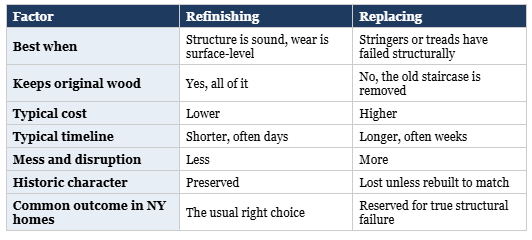
For most New York staircases, the table leans clearly toward refinishing or partial rebuilding, with full replacement saved for stairs that are genuinely unsafe.
Why Local New York Experience Matters
Reading a staircase accurately takes experience with the wood and the conditions it lived in. New York's seasonal humidity swings move wood hard, so a local team knows which gaps and squeaks are harmless surface effects and which point to structural trouble. We also know that older New York homes hide things: water damage under carpet, layers of paint over sound wood, quick fixes by past owners. Since 1990 we have read these staircases across Long Island City, Brooklyn, and upstate New York, and that experience keeps homeowners from replacing wood that only needed refinishing.
Cost and Value: What Goes Into the Decision
The price of either path depends on real conditions:
- Refinishing cost rises with stair size, the number of balusters, paint removal, and the finish you choose.
- Replacement or rebuild cost rises with the amount of structural work and custom matching needed.
- Hidden conditions like rot under old carpet can shift scope once work begins.
The value question is where most owners find clarity. Refinishing wooden stairs usually costs less, keeps original material you cannot replace, and protects the character of a New York home. Replacement makes sense only when structure has failed. For the great majority of staircases, the better return comes from restoring what you already have rather than starting over.
5 Practical Tips You Can Use Today
Before you decide, gather a little evidence.
- Test the treads. Walk every step and press near the open edge. Firm is good. Soft suggests checking for rot.
- Strip a hidden patch. Remove finish from a small, out-of-sight area. Sound wood underneath points to refinishing.
- Look at the stringers. If you can see them, check for cracks. Sound stringers favor keeping the staircase.
- Test for sway. Climb and feel for bounce. A solid staircase rarely needs replacing.
- Resist the teardown urge. Dark and worn is not the same as failed. Get a real assessment first.
Frequently Asked Questions
Is refinishing wooden stairs cheaper than replacing them? In most cases, clearly yes. Refinishing keeps sound original wood and costs less than removing and rebuilding a whole staircase.
How do I know if my staircase is sound enough to refinish? Firm treads, solid stringers, and no rot or sway are the green lights. A professional inspection confirms it quickly.
My staircase looks awful. Can refinishing really save it? Often, yes. A failed finish makes wood look far worse than it is. Stripping it back usually reveals sound, attractive wood.
Can I refinish most of the staircase and rebuild just a few parts? That is the most common path. We refinish the sound staircase and rebuild only the parts that have failed, matched to the original.
When does replacement truly make sense? When the structure has failed, cracked stringers, widespread rot, or a staircase that is unsafe to use. That is the minority of cases.
Customer Success Story
James C handed us original double-hung windows from around 1790 along with a Dutch door from the same era. Plenty of people would have replaced both. Instead our team removed, restored, and reinstalled the windows with new weatherstripping, then took the door apart and rebuilt it to work like new. "They are expert craftspeople," he said. That project is the refinish-versus-replace question in miniature. The old wood was not failing. It needed skilled restoration, not the dumpster. Your staircase very likely tells the same story.
Fifty Three Restorations Serving the Astoria Community and Beyond in Long Island City
Fifty Three Restorations works to meet the woodworking needs of the local community across Long Island City. With our location near Queens, we proudly handle staircase refinishing and rebuilding for homeowners and property owners throughout New York City.
Our shop sits at 38-16 Skillman Ave # B, Long Island City, NY 11101. From there our team reaches clients in Astoria, Sunnyside, Woodside, Greenpoint, and Williamsburg, and we serve customers across Queens, Brooklyn, Manhattan, and the surrounding communities. New York homes deserve woodwork that lasts, and our New York roots run deep.
Quick Access Information
- 📍 About 10 minutes from the Ed Koch Queensboro Bridge and Gantry Plaza State Park
- 🚗 Easy access via the Brooklyn-Queens Expressway (I-278) and Queens Boulevard
- 🌆 Serving residents across Astoria, Sunnyside, and Woodside
We know that finding skilled staircase refinishing and rebuilding close to home matters. That is why property owners across New York trust Fifty Three Restorations for reliable, careful work. From Long Island City brownstones to upstate farmhouses, our crews bring the same standards to every project. We have served the New York preservation community since 1990, and partners like the Central Park Conservancy and the New York Landmarks Conservancy have trusted our hands on landmark buildings.
Get Refinishing Wooden Stairs Services in Queens Now
Call us today at (212) 566-1053 or contact us online to request a proposal for your project.
Driving Directions from Astoria to Fifty Three Restorations
From Astoria, head south on 31st Street, then connect to Northern Boulevard heading west. Turn onto Skillman Avenue and follow it to 38-16 Skillman Ave # B in Long Island City. Most drivers reach our shop in under 15 minutes. The map below shows the route into our Long Island City location.
<iframe src="https://www.google.com/maps/embed?pb=!1m18!1m12!1m3!1d3022.670979246106!2d-73.9260912!3d40.747264799999996!2m3!1f0!2f0!3f0!3m2!1i1024!2i768!4f13.1!3m3!1m2!1s0x89c25f2822fcc717%3A0xb0f6d7a4c4f548ac!2sFifty%20Three%20Restorations%20Inc!5e0!3m2!1sen!2sph!4v1776106836033!5m2!1sen!2sph" width="600" height="450" style="border:0;" allowfullscreen="" loading="lazy" referrerpolicy="no-referrer-when-downgrade"></iframe>
Business Hours and Contact
Reaching Fifty Three Restorations in Long Island City is simple. Here are the details you need.
- Business name: Fifty Three Restorations
- Address: 38-16 Skillman Ave # B, Long Island City, NY 11101
- Phone: (212) 566-1053
- Email: info@fiftythreerestorations.com
- Website: https://fiftythreerestorations.com
Hours
- Monday to Friday: 8:00 AM to 4:30 PM
- Saturday: By appointment
- Sunday: Closed
Our Long Island City shop serves clients across New York. Call during business hours and a member of our team will talk through your project, answer questions, and set up a site visit. Prefer to write first? Send a note through our contact us online page and we will reply quickly. (Please confirm current hours by phone before visiting.)
Ready to Start Your Project
Stuck at the refinish-or-replace fork? An honest inspection points you the right way and usually saves the original staircase. Let us take a look.
Fifty Three Restorations has served New York since 1990, and our Long Island City team is ready to help. Get a proposal today, and let us show you what careful refinishing wooden stairs can do for your home. Spots on our project calendar fill up through the busy New York seasons, so reaching out early gives you the best schedule.
Call (212) 566-1053 or contact us online to get a proposal. You can also visit our shop at 38-16 Skillman Ave # B, Long Island City, NY 11101. Your staircase has a story worth keeping, and we would be glad to help you protect it.
Follow Fifty Three Restorations
See more of our New York restoration work and connect with our Long Island City team online.
- Facebook: https://www.facebook.com/iconicnewyorkbuildings
- Instagram: https://www.instagram.com/53restorations/
- LinkedIn: https://www.linkedin.com/company/fifty-three-restorations-inc/
Sources
- USDA Forest Products Laboratory, Wood Handbook (Chapter 13: Drying and Control of Moisture Content and Dimensional Changes) | U.S. Department of Agriculture, Forest Service | 2021 | https://research.fs.usda.gov/treesearch/62261
- The Secretary of the Interior's Standards for the Treatment of Historic Properties | National Park Service | Accessed 2026 | https://www.nps.gov/orgs/1739/secretary-standards-treatment-historic-properties.htm
Explore More Insights
Get Started with Your Project
Contact us today to schedule a consultation.
